The Critical Imperative of PT100 Sensor Placement in Autoclave Sterilization: Internal Validation vs. External Approximation
Introduction
In medical infection control, laboratory research, and veterinary science, the autoclave is the ultimate firewall against pathogens. Through high-pressure saturated steam, these thermodynamic vessels sterilize by coagulating and denaturing the structural proteins of microorganisms. But an autoclave's efficacy depends entirely on its ability to reach, maintain, and uniformly distribute specific temperatures — typically 121°C or 134°C — over a defined period. Validating that process with precision temperature monitoring is not a recommendation; it is an absolute regulatory and physical necessity.
The Platinum Resistance Temperature Detector (RTD), specifically the PT100 sensor, is the industry standard for this task. Operating on the principle that the electrical resistance of platinum changes predictably with temperature — measuring exactly 100 ohms at 0°C — the PT100 offers unmatched accuracy, stability, and repeatability across thousands of thermal cycles.
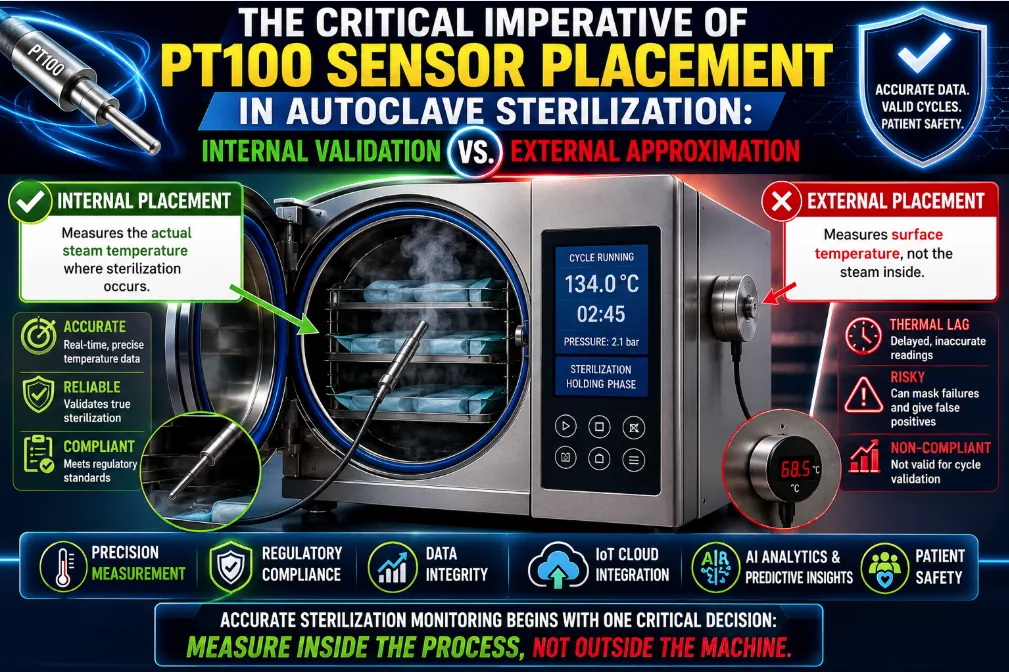
When modernizing or retrofitting traditional sterilization equipment for integration into medical IoT networks, one fundamental question arises: where should the PT100 sensor be placed — inside the autoclave, or next to it? The unequivocal answer is that the sensor must be placed inside the autoclave's fluid or steam path. Placing a sensor "next to" or on the external chassis is scientifically invalid for sterilization monitoring. This article explores the thermodynamic principles behind that rule, the internal placement strategies required for accurate cycle analysis, the challenges of retrofitting legacy equipment, and how this precise telemetry integrates into modern, stateless data architectures for predictive analytics.
Part 1: The Physics of Steam Sterilization and Thermodynamic Curves
To understand why placement is critical, one must first understand what a PT100 is actually measuring during a cycle. The goal is not simply to record "heat" — it is to monitor a highly specific thermodynamic curve mapping the relationship between time, temperature, and steam saturation.
Saturated Steam vs. Dry Heat
Autoclaves rely on saturated steam. Water vapor holds significantly more thermal energy — the latent heat of vaporization — than dry air at the same temperature. When saturated steam contacts a cooler object, it condenses, instantly transferring massive amounts of latent heat directly to the microorganisms and causing rapid destruction. If the chamber contains pockets of trapped air, the steam cannot properly contact the load. Air is an excellent insulator, so the temperature profile of a steam/air mixture is entirely different from that of pure saturated steam.
The Importance of the Thermodynamic Curve
Unlike industrial platforms that track the steady-state output of rotating machinery, an autoclave operates in distinct, highly dynamic phases: a conditioning/purge phase (air removed by gravity displacement or vacuum pulses and replaced by steam); a heating phase (temperature rises to setpoint); a sterilization/holding phase (temperature held strictly at setpoint — e.g. 134°C for 3 to 5 minutes for prions, or 15 minutes for standard loads at 121°C); and an exhaust/drying phase (steam evacuated, pressure dropped, load dried). The PT100 captures the telemetry of these curves. A deviation of even one degree Celsius during the holding phase can produce a failed cycle — so the sensor must sit exactly where the thermal dynamics are most critical and most vulnerable.
Part 2: The Fallacy of External Placement
Placing a PT100 "next to" the autoclave, or mounting it externally on the outer chassis, is a fundamentally flawed approach for sterilization validation.
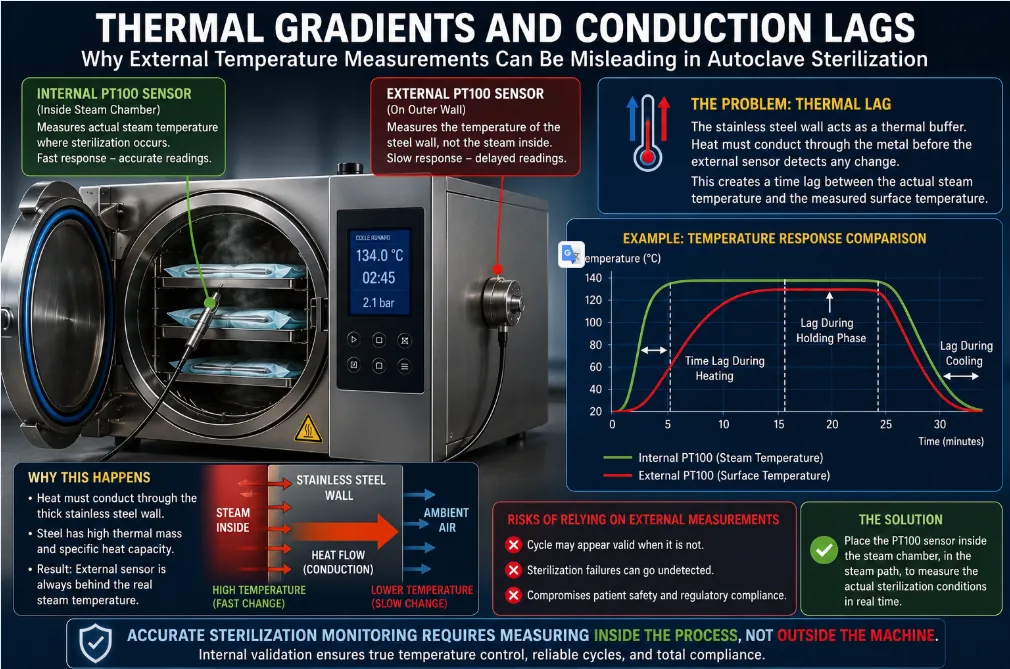
Thermal Gradients and Conduction Lags
By Fourier's Law of thermal conduction, the rate of heat transfer through a material is proportional to the negative temperature gradient and the area of flow. The heavy stainless-steel walls of a pressure vessel have significant thermal mass and specific heat capacity. A PT100 on the outside measures the surface temperature of the steel, not the core temperature of the steam. The steel acts as a thermal buffer, creating a massive time lag: by the time the external surface reaches 134°C, the internal chamber may have held that temperature for several minutes. Conversely, if the internal temperature suddenly drops due to a steam-generator failure, the external steel holds its heat, masking the failure and producing a false positive — a dangerous scenario in medical contexts.
Ambient Interference
A sensor placed outside is also subject to the ambient environment. HVAC systems, drafts, room-temperature fluctuations, and nearby heat-generating equipment all skew the RTD's resistance readings.
Mathematical Proof of PT100 Sensitivity
The relationship between resistance and temperature for a PT100 is defined by the Callendar-Van Dusen equation. For temperatures above 0°C:
where R(0) = 100 Ω (resistance at 0°C), A = 3.9083 × 10⁻³ °C⁻¹, and B = −5.775 × 10⁻⁷ °C⁻². Evaluating this equation at the sterilization setpoints gives a PT100 resistance of 146.44 Ω at 121°C and 151.33 Ω at 134°C. The sensitivity (dR/dT) around these temperatures is approximately 0.375–0.377 Ω/°C — nearly constant — which means a temperature error of just 1°C produces a measurable resistance change on the order of 0.36 Ω. Because the sensor is this sensitive, any external environmental factor immediately alters the electrical resistance and destroys the integrity of the data required for strict medical compliance. For the data to be valid, the PT100 element must be fully immersed in the thermodynamic environment it is meant to measure.

Part 3: Internal Placement — The Drain Line
If external placement is invalid, where inside the autoclave should the PT100 go? For standard chamber validation and routine monitoring, the universal standard is the drain line.
The Cold Spot Principle
In thermodynamics, heat rises and cold descends. Inside an autoclave, air is denser and heavier than steam. As steam is injected — usually from the top or sides — it acts like a piston, forcing the heavier, cooler air down toward the bottom of the chamber and out through the drain. The drain line is therefore universally recognized as the coldest spot in the autoclave.
Why the Drain Line Is Critical
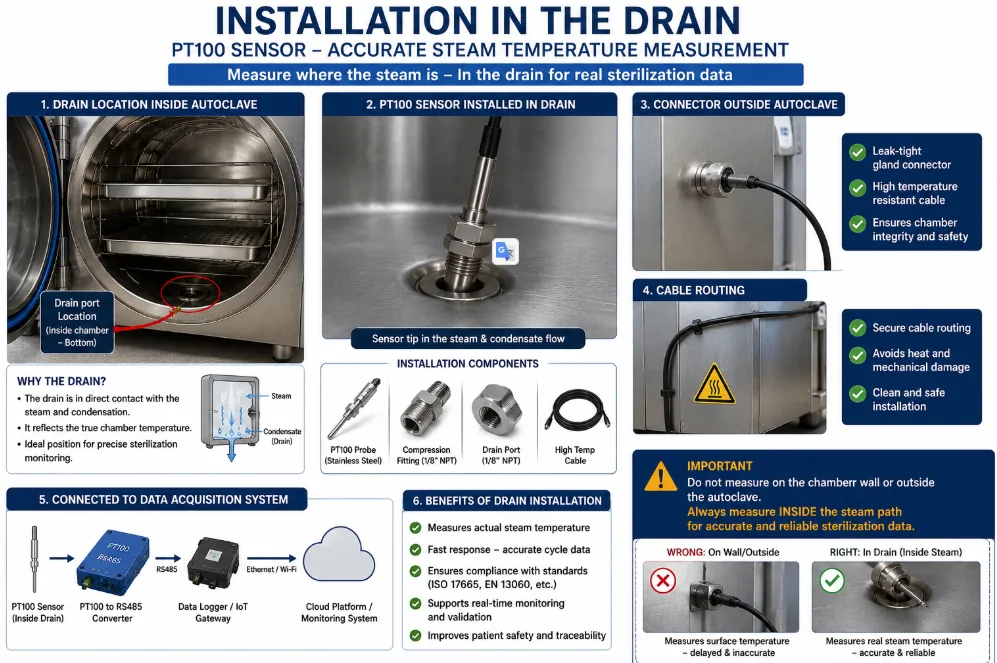
- Guarantee of chamber saturation: if the drain-line sensor registers that the target temperature (e.g. 121°C) has been reached, it provides physical certainty that the rest of the chamber — inherently hotter — has reached or exceeded it.
- Air-pocket detection: if air elimination fails (a faulty vacuum pump or a clogged filter), heavier air pools at the bottom near the drain, and the PT100 detects a depressed reading, signaling that saturated-steam conditions were not met.
- Non-intrusive to the load: a drain-line sensor does not interfere with loading or unloading medical instruments or veterinary surgical packs.
Installation in the Drain
The PT100 is installed directly into the plumbing of the exhaust line, as close to the chamber exit as possible, before any steam traps or condenser units. It is typically housed in a thermowell — a protective metallic tube that lets the sensor read the fluid temperature without direct exposure to continuous corrosive moisture and pressure, and allows replacement without draining the system.
Part 4: Internal Placement — Chamber and Load Sensing
While the drain line is the standard for chamber validation, advanced medical IoT systems and rigorous protocols — Installation, Operational, and Performance Qualification (IQ/OQ/PQ) — require monitoring the actual medical load itself.
Validation Ports and Feedthroughs
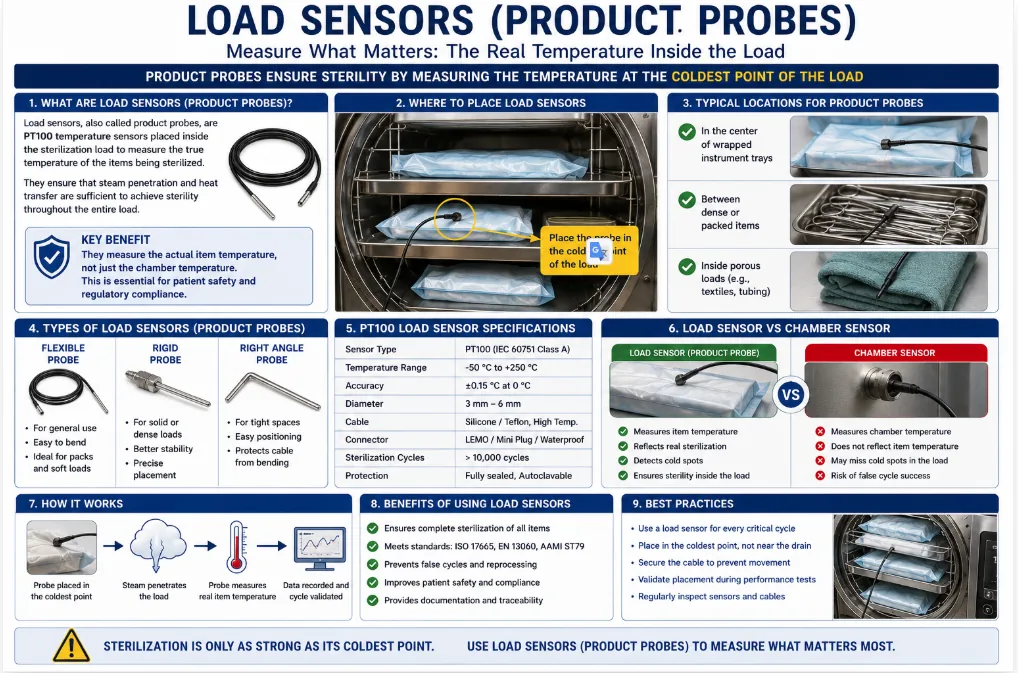
To place a PT100 directly into the chamber, the autoclave must have a validation port: a specialized, threaded orifice for routing sensor cables into the pressure vessel. Because the chamber operates under high pressure (typically 2 to 3 bar absolute), cables cannot simply be fed through a gap — they must be secured with a pressure-tight gland or feedthrough (often Teflon or silicone) that prevents steam escape while protecting the RTD's internal wiring.
Load Sensors (Product Probes)
In complex scenarios — dense surgical kits, porous loads such as gowns and drapes, or large liquid volumes — monitoring chamber temperature is insufficient. The outer layers of a dense pack may reach 134°C while the inner core takes an additional 10 to 15 minutes to reach equilibrium. Here, flexible high-temperature PT100 probes are routed through the validation port and embedded directly into the load: for liquid loads, inside a reference bottle of water identical to the products being sterilized; for porous loads, buried in the center of the densest pack. This placement generates a highly specific thermodynamic curve reflecting the exact core temperature of the instruments, providing the highest possible tier of sterilization assurance.
Part 5: The Retrofitting Challenge in Medical IoT
Modernizing legacy sterilization equipment presents unique engineering challenges. Many clinics and health ministries operate older, highly reliable autoclaves that lack digital monitoring. Retrofitting them with PT100 sensors to feed a centralized IoT hub requires careful attention to pressure-vessel regulations.
The Problem with Pressure-Vessel Integrity
An autoclave is a pressurized boiler. In most jurisdictions, drilling a new hole into the pressure vessel to install a PT100 is strictly prohibited: it immediately voids the safety certification (ASME boiler codes in the USA, the Pressure Equipment Directive in Europe) and creates a catastrophic explosion hazard.
Non-Destructive Retrofitting Solutions
Utilizing existing pipework (T-junctions): the most effective method is to intercept the existing exhaust or drain plumbing. Installing a heavy-duty stainless-steel T-junction into the drain line introduces a PT100 thermowell directly into the steam path without ever modifying the main pressure chamber.
Surface mounting on exhaust lines (the exception to the rule): if intercepting the plumbing is impossible, a specialized surface-mount PT100 can be clamped tightly against the bare metal of the exhaust pipe, as close to the chamber as possible. Crucially, this differs entirely from mounting "next to" the chassis — the sensor is directly coupled to the steam-carrying pipe. To make it valid, the sensor and pipe must be heavily wrapped in industrial thermal insulation to isolate the PT100 from ambient air and force it to measure only the conductive heat of the pipe wall. Even so, this method introduces a slight thermal lag and is a secondary fallback to direct fluid immersion.
Signal Integrity: 3-Wire and 4-Wire Configurations
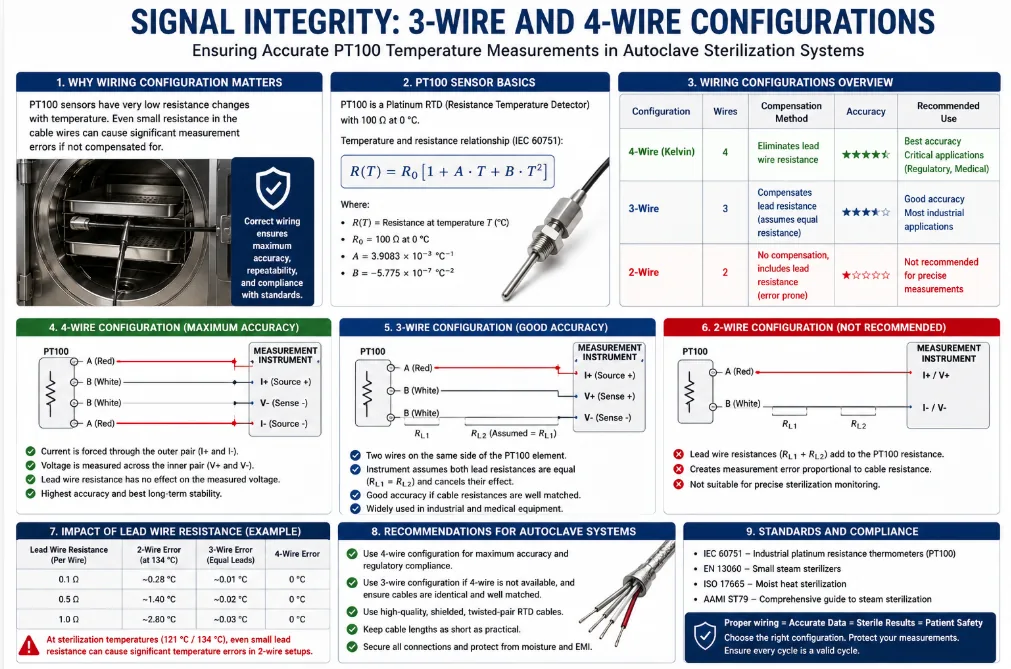
Once the PT100 is correctly placed, the micro-voltage signals must be extracted accurately. Because PT100s rely on minute resistance changes, the natural resistance of the copper lead wires connecting the sensor to the digital transmitter can skew the reading. To eliminate this, retrofitted medical IoT systems use 3-wire or 4-wire configurations. A 4-wire configuration provides a true Kelvin connection — a constant current through two wires, voltage measured across the other two — canceling cable resistance entirely, regardless of length. A 3-wire configuration compensates for lead resistance when the lead resistances are matched.
Part 6: Bridging the Physical to the Digital — RS485 to IP Networks
Extracting analog data from a perfectly placed PT100 is only half the equation. To build a scalable, modern medical infrastructure, this localized data must be digitized and securely transmitted to centralized processing environments.

The Role of RS485 Protocols
In clinical and hospital environments, equipment is spread across large areas and subject to high electromagnetic interference (EMI) from other devices. The analog PT100 signal is first fed into a local transmitter or PLC that converts the resistance reading into digital form. This telemetry is best transmitted locally via RS485, which uses differential signaling over two intertwined wires: EMI spikes affect both wires equally, so the receiver cancels the noise. This makes RS485 exceptionally robust for chaining multiple autoclaves — up to 32 devices over distances up to 1200 m — across a facility, using Modbus RTU framing and 120 Ω termination on a daisy-chain topology.
The RS485-to-RJ45 Bridge
RS485 is a serial protocol, incompatible with modern cloud infrastructures. To bridge legacy hardware and the cloud, an RS485-to-RJ45 (Ethernet) gateway is employed. This bridge is the critical translator: it ingests the continuous stream of time-series data from the PT100 network, packetizes it into standard IP protocols (TCP/IP or MQTT), and routes it over the hospital LAN via a standard RJ45 connection — creating a seamless pipeline from the deepest, highest-pressure corner of the chamber directly out to the broader network.
Part 7: Stateless Server Architecture and AI Integration
The continuous telemetry from correctly placed PT100 sensors across hundreds of autoclaves produces massive volumes of high-frequency, time-series data. Handling it efficiently, securely, and reliably requires a modernized backend.
The Necessity of Stateless Architecture
When processing sensitive medical telemetry — particularly across borders or diverse clinic networks — traditional stateful architectures, where the server retains memory of individual client sessions, become bottlenecks prone to synchronization errors and hard to scale. A stateless architecture is optimal for medical IoT ingestion: every packet from the RJ45 bridge (autoclave ID, timestamp, and exact PT100 reading) is an independent, self-contained transaction, and the server does not need the previous data point to process the current one.
- Infinite scalability: as a platform expands to hundreds of clinics, load balancers distribute incoming PT100 data across any available server instantly, without session affinity.
- Enhanced security: stateless designs reduce the attack surface — with no session data stored on edge servers, a compromised server yields no historical clinic data.
- Fault tolerance: if a server processing curve data goes offline, the next packet is routed to a healthy server, ensuring zero data loss during a critical cycle.
Cloud Integration and Predictive AI
Once stateless servers ingest and authenticate the data, it is routed to centralized, high-RAM databases built for high-throughput telemetry. Because the sensor was placed inside the thermodynamic environment, the data represents a pure, unadulterated thermodynamic curve — high-fidelity input for machine-learning platforms. These models analyze the shape of the curve in real time: predictive maintenance flags micro-deviations (if the chamber takes 5% longer to reach 134°C than last week, a degrading heating element or clogging drain filter is surfaced before a cycle fails), and anomaly detection compares live drain-line data against historical baselines to catch subtle steam-pressure drops causing localized temperature depression. Had the PT100 been placed outside, the thermal lag and ambient interference would render the data too noisy for these models — the accuracy of the AI is entirely bound by the physical placement of the sensor.
The core principle: the accuracy of every downstream layer — signal conditioning, RS485 transport, stateless ingestion, and AI analysis — is bounded by one physical decision made at the chamber. Get the placement right, and the entire pipeline produces valid, defensible sterilization data. Get it wrong, and no amount of software can recover it.
Standards, Compliance, and the F0 Metric
Correct placement is what makes compliance with the governing standards physically meaningful. PT100 sensor characteristics are defined by IEC 60751; moist-heat sterilization is governed by ISO 17665; small steam sterilizers by EN 13060; and comprehensive steam-sterilization guidance by AAMI ST79. None of these can be satisfied by a sensor reading the vessel's surface rather than the steam.
The point is sharpest with the F0 metric, the accumulated lethality of a cycle expressed as equivalent minutes at 121.1°C. F0 integrates the actual measured temperature over time to prove that sufficient microbial lethality was delivered, and it is the standard basis for validating 121°C cycles. That calculation is only as trustworthy as the temperature feeding it: a lagging external sensor over-reports lethality during cooling and under-reports it during heating, corrupting the F0 result in both directions. A drain-line or load PT100 measuring true steam temperature produces an F0 value that genuinely reflects the sterilization delivered — which is exactly what auditors, regulators, and patient safety require. Placement, in other words, is not a detail beneath compliance; it is the physical precondition for it.
Conclusion
PT100 sensor placement in sterilization is not a matter of convenience; it is governed by the rigid laws of thermodynamics and the strict requirements of medical compliance. Placing a sensor "next to" an autoclave or on the external chassis is fundamentally invalid — it measures ambient conditions and the vessel's thermal mass, producing severe latency and dangerous inaccuracies that cannot validate the destruction of pathogens. To capture the vital thermodynamic curves of a cycle, the PT100 must sit inside the steam path: the drain line as the critical cold spot for routine validation, and direct insertion via validation ports for complex loads. As medical monitoring moves toward interconnected digital systems, retrofitting legacy equipment demands intelligent engineering — T-junctions and 4-wire configurations to extract precise analog data without compromising pressure-vessel integrity. By bridging that data through RS485-to-RJ45 gateways and processing it via robust, stateless architectures, organizations transform simple temperature readings into powerful, AI-driven predictive insights — ensuring the highest standards of safety and efficiency in global healthcare infrastructure.
Frequently Asked Questions
Where should a PT100 sensor be placed in an autoclave?
Inside the steam path. The drain line is standard for chamber validation because it is the coldest spot; for dense or porous loads, a flexible probe is embedded in the load via a validation port. External chassis placement is scientifically invalid.
Why is the drain line the standard location?
Steam displaces heavier, cooler air toward the bottom of the chamber and out the drain, making it the coldest spot. If the drain reaches setpoint, the hotter chamber has too — and failed air removal shows up there as a depressed reading.
What is the PT100 resistance at 121°C and 134°C?
By IEC 60751, approximately 146.44 Ω at 121°C and 151.33 Ω at 134°C, with sensitivity near 0.375–0.377 Ω/°C — so a 1°C error is a meaningful ~0.36 Ω change.
Can I retrofit a legacy autoclave without drilling the pressure vessel?
Yes — drilling voids the vessel's safety certification. Use a stainless-steel T-junction on the existing drain/exhaust plumbing to introduce a thermowell, or an insulated surface-mount PT100 on the exhaust pipe as a fallback.
Why use a 4-wire PT100 configuration?
It provides a true Kelvin connection that cancels lead-wire resistance entirely, regardless of cable length — essential when measuring the minute resistance changes a PT100 relies on.